Low ferritin: are you deficient, why, and should you take iron?
If you've felt exhausted, had your iron checked, and been told it's "fine, you're not anaemic," this one is for you. Low iron stores, also called non-anaemic iron deficiency, often get normalised by conventional medicine and are rarely investigated. Confusingly, the solution isn't always as simple as taking more iron: whether iron reaches your stores depends on absorption, blood loss, inflammation and stomach acid, and each of those is fixable.
In short
- Heme vs non-heme absorption
- Iron from meat is absorbed at roughly 15 to 35 percent; iron from plants at about 2 to 20 percent, and often the low end.
- The spinach myth
- Spinach is non-heme iron plus oxalates that block it. Red meat, liver and shellfish provide far more absorbed iron per serving.
- Low ferritin before anaemia
- Symptoms often appear once ferritin drops below about 30 to 50, which still sits inside many labs' normal range.
- Time the blockers
- Tea, coffee, matcha and calcium cut absorption sharply. Keep them 1 to 2 hours from iron-rich meals, and add vitamin C to the meal.
- If you supplement
- A single morning dose beats split doses, because each dose spikes hepcidin. Alternate days refills stores at a similar rate to daily and can be gentler on the stomach.
- Three routes to low iron
- You're either losing it (periods, silent gut bleeding), not absorbing it (coeliac, H. pylori, low stomach acid, acid-suppressing meds), or not getting enough for your demand.
- Overload is rarer than the warnings
- Genuine iron overload clusters in specific cases like haemochromatosis or years of unneeded high-dose iron. Correcting a confirmed deficiency, especially if you menstruate, rarely causes it.
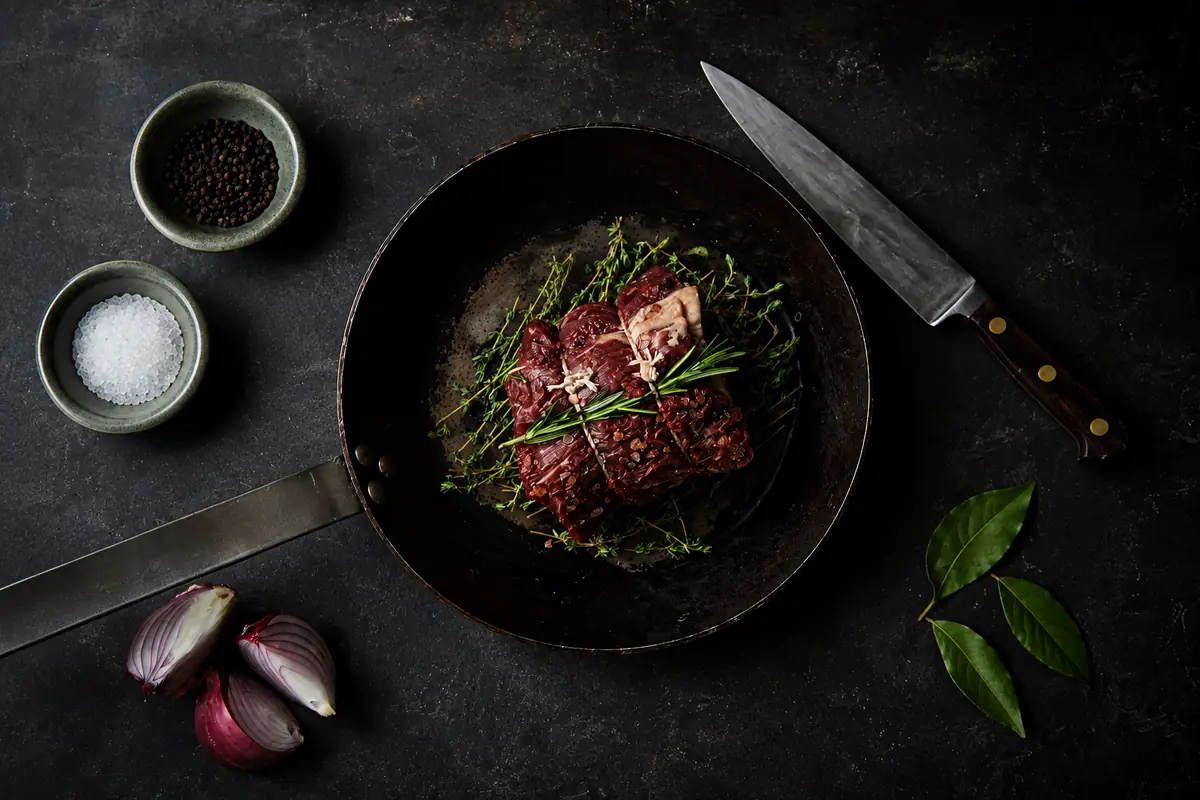
Iron’s central role is delivering oxygen to your tissues: it sits at the core of haemoglobin, which carries oxygen from your lungs into every cell, and in your mitochondria it carries the electrons that turn that oxygen into cellular energy. It’s also required for DNA synthesis and immune function. When iron runs low, energy production falls with it.
There are three separate questions here, and almost everyone collapses them into a single verdict. This article takes them one at a time.
- Are you deficient? A question about measurement.
- Why are you deficient? A question about cause.
- Should you take iron? A question about treatment.
Are you deficient?
Question 1 of 3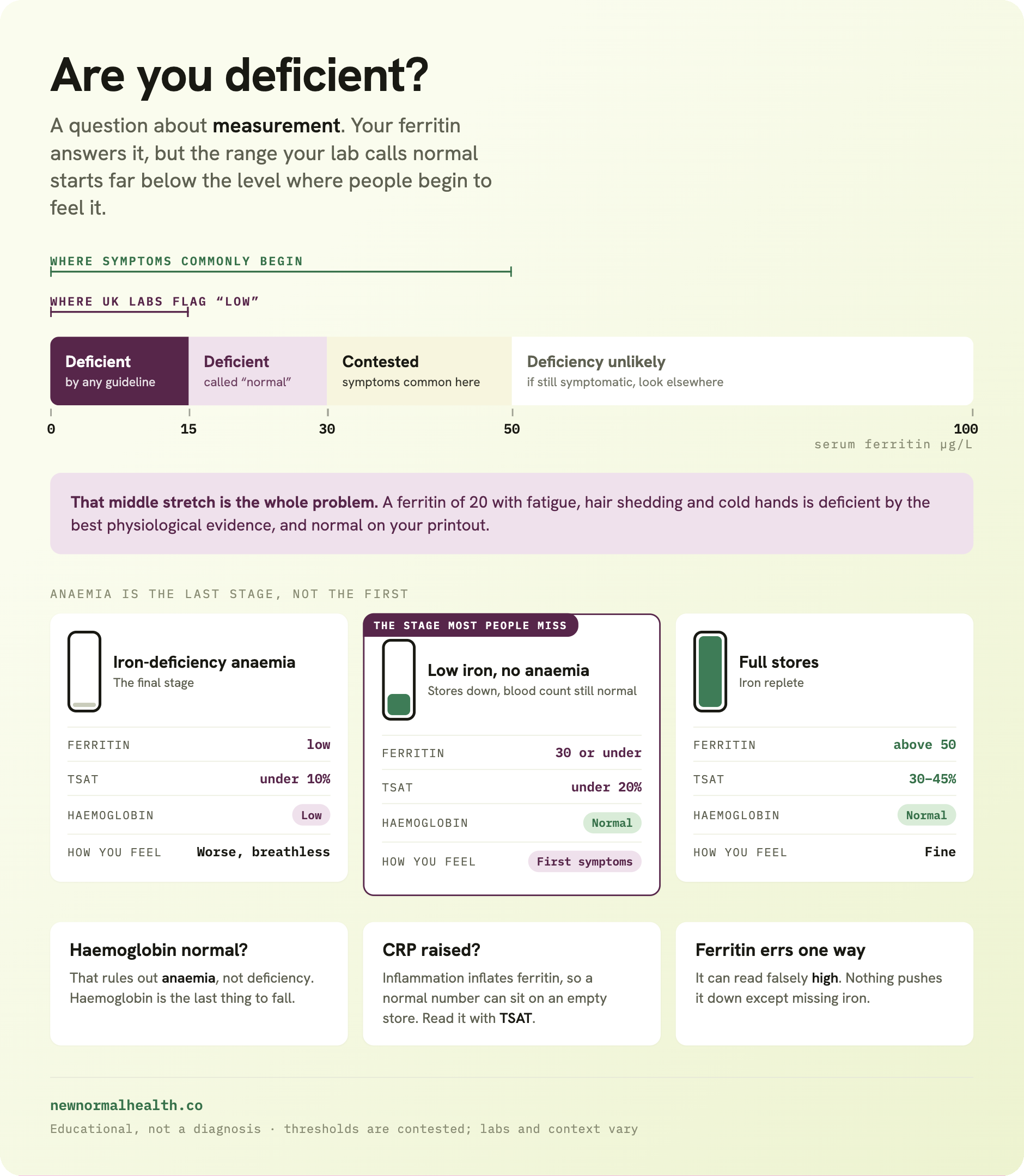
The signs of low iron, even when you’re “not anaemic”
Anaemia is the final stage of iron depletion. Your body spends its stored iron first, then its circulating iron, and only once that runs out does your haemoglobin fall far enough to be labelled anaemia. That entire earlier stretch has a name: iron deficiency without anaemia. Your standard blood count can read normal throughout.
And it has symptoms. In one analysis of women with iron deficiency, the most common complaints were weakness (around 87%), fatigue (around 82%), poor memory (around 72%), feeling cold (around 72%), and hair loss (around 70%). None of that needs anaemia to appear. The enzymes your mitochondria use to make energy depend on iron, so a shortfall registers as tiredness long before your red blood cells change.
So “you’re not anaemic” can be accurate and unhelpful at once: it answers a different question from the one you came in with.
Low ferritin symptoms: fatigue, hair loss, cold hands, low mood
If iron deficiency without anaemia is the stage, ferritin is how we see it. Ferritin is your iron storage protein, so a low ferritin tells you the reserve is running down while everything else still reads normal. The symptoms form a recognisable cluster:
- Fatigue that sleep doesn’t fix, alongside low tolerance for exercise. In non-anaemic women with low ferritin, iron cut fatigue in a placebo-controlled trial, and the benefit concentrated in those whose ferritin sat under about 50 (Verdon et al., BMJ, 2003).
- Hair shedding. Diffuse hair loss is one of the classic low-iron signs in women, and it often appears before anaemia does.
- Cold hands and feet, and feeling cold when the room is comfortable for everyone else.
- Brain fog and flat mood. Iron is a cofactor for the enzymes that make dopamine and serotonin, so a shortfall flattens focus and mood. Iron treatment improved cognitive performance in iron-deficient young women (Murray-Kolb & Beard, American Journal of Clinical Nutrition, 2007).
- Restless legs at night, and sometimes brittle nails.
If several of those describe you and your ferritin sits near the bottom of the range, take it seriously, with or without the word “anaemia” on your results.
Why a “normal” ferritin can still be too low
Ferritin is easy to misread, for two reasons.
The reference range is enormous. Depending on the lab, “normal” ferritin runs from about 12 to 150 or higher, and the symptoms above tend to arrive once it drops below roughly 30 to 50, well inside that “normal” band. So you can be flagged as fine and still sit in the range where people feel awful. I won’t hand you a target number to self-diagnose against, but do know your actual figure rather than accept “it’s in range.” If you’re symptomatic, ask your GP for a full iron panel with ferritin, not just a haemoglobin.
Ferritin also rises with inflammation. As an acute-phase protein it climbs with any infection, flare, or low-grade inflammatory process, so a normal-looking number can sit on top of a low store (Kell & Pretorius, Metallomics, 2014; Thurnham et al., American Journal of Clinical Nutrition, 2010).
That wide range is how low stores get normalised: a ferritin of 25 sits inside the range, so nobody flags it. Read your number against your symptoms, and don’t let a mid-range result close the conversation.
How to read your iron panel
If you’ve had bloods done, the iron markers mean more read together than ferritin does alone. Bring anything unclear or out of range back to your GP.
| Marker | What it tells you | Typical lab “normal” | Notes |
|---|---|---|---|
| Ferritin | Your iron stores | ~12 to 150+ ng/mL | Symptoms often appear below ~30 to 50. Rises with inflammation, so a normal number can sit on top of a low store. |
| Serum iron | Iron circulating right now | fluctuates | A snapshot that swings with meals and time of day, so it means little on its own. |
| Transferrin saturation (TSAT) | How full your iron transport is | ~20 to 45% | Below about 20% points toward deficiency. |
| TIBC / transferrin | Spare iron-carrying capacity | lab range | Runs high when iron is low, as the body makes more carriers to scavenge what it can. |
| Haemoglobin (full blood count) | Whether it has become anaemia | lab range | Normal here does not rule out low iron. Haemoglobin is the last thing to fall. |
| CRP (or ESR) | Inflammation, as context | low when settled | If this is raised, read a “normal” ferritin with suspicion. |
| Soluble transferrin receptor (sTfR) | True vs inflammation-driven deficiency | specialised test | Not affected by inflammation. Request it when ferritin and CRP give a mixed picture. |
The classic pattern of iron deficiency is a low ferritin with a low transferrin saturation and often a high TIBC, even while haemoglobin still reads normal. The complication is inflammation: if your CRP is raised, ferritin can look reassuring while your usable iron is low, and that is when to request soluble transferrin receptor. Use this to read the numbers you already have and walk into your GP appointment with a specific question, not to self-diagnose.
Why are you deficient?
Question 2 of 3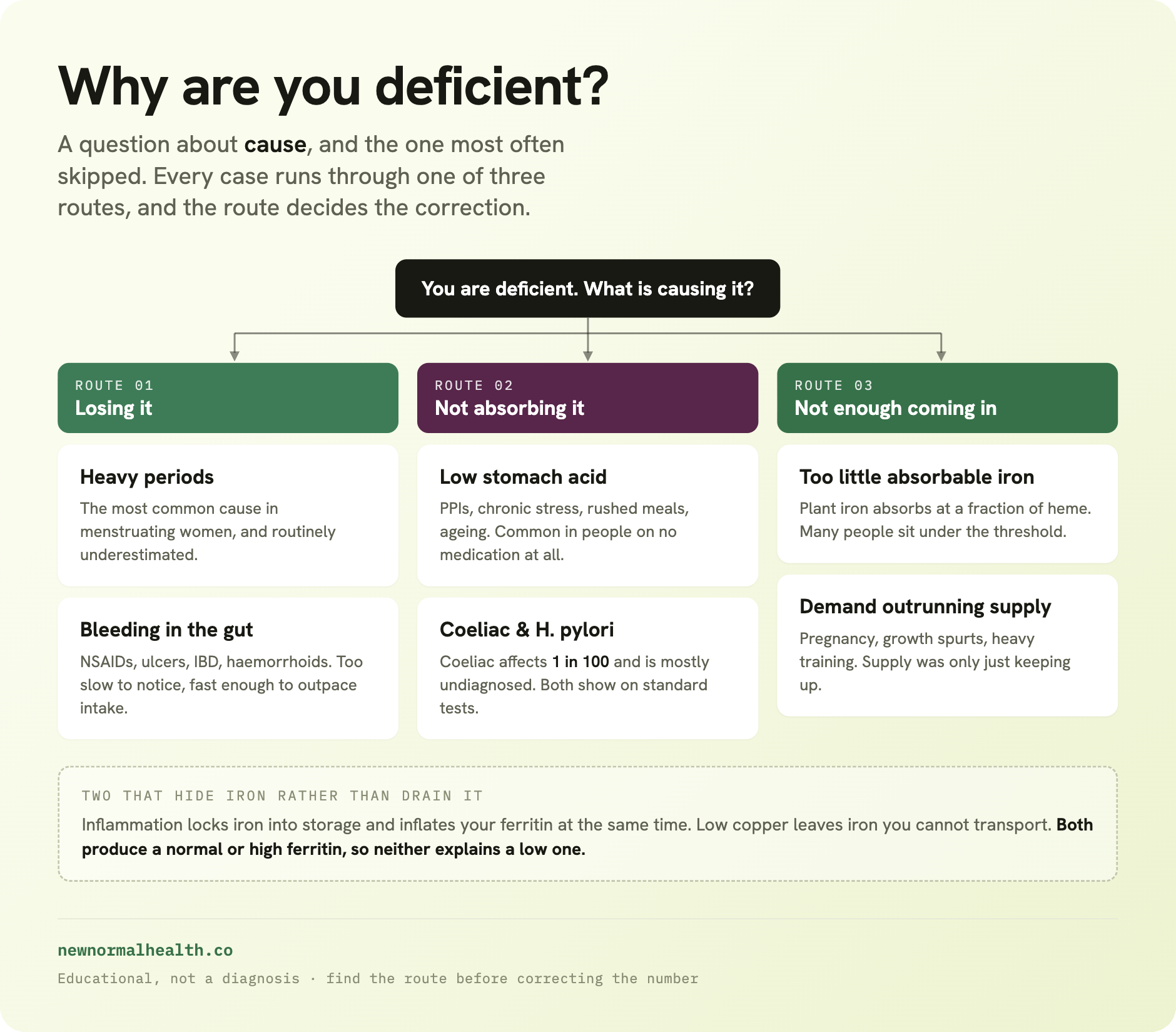
The hidden iron depleters
Something is draining your iron or hiding it, and every case reduces to one of three problems: you’re losing iron faster than you take it in, you’re not absorbing it, or demand (pregnancy, growth, heavy training) has outrun supply. These are the factors that get missed.
Blood loss you’ve underestimated
Blood loss outpacing intake is the most common cause of all, and it takes two forms.
- Periods heavier than you think. Monthly loss is routinely underestimated. Soaking through protection every hour, passing large clots, or bleeding past seven days can outpace anything you eat.
- The gut, with nothing to see. Ulcers, inflammatory bowel disease, haemorrhoids and regular anti-inflammatory painkillers such as ibuprofen can each cause slow, continuous bleeding you would never notice.
The amounts are too small to see and large enough to matter: against an absorption ceiling of 1 to 2 mg a day, a slow bleed can consume everything you take in. In older adults, unexplained iron deficiency warrants a doctor formally ruling out bowel causes.
Low stomach acid
Iron needs stomach acid to be freed from food and converted into the form you absorb, so whatever lowers your acid lowers your iron. Several things do:
- Acid-suppressing medication. The PPIs (omeprazole, esomeprazole, lansoprazole, pantoprazole) switch acid off for most of the day. Long-term use reduces uptake of both dietary iron and supplements (Lam et al., Gastroenterology, 2017), and these drugs are frequently continued years past their original indication. If you have been on one for years, ask your prescriber whether it is still needed; do not stop it on your own.
- Stress and eating on the run. Stomach acid production depends on being in a rested state. Eating while stressed, rushed or distracted suppresses it, so this is common in people who take no medication at all.
- Ageing, H. pylori, and low iron itself. Acid output declines with age, H. pylori infection lowers it, and low iron impairs acid production directly, so deficiency and poor absorption reinforce each other.
Vitamin C compensates in part, doing chemically what the acid would have done.
Silent malabsorption: coeliac and H. pylori
Two conditions here are common and mostly undiagnosed, so don’t rule either out on the basis that nobody has mentioned it to you.
- Coeliac disease affects around 1 in 100 people, and most who have it don’t know. It damages the upper small intestine, which is precisely where iron is absorbed, and unexplained iron deficiency is one of its most frequent presentations. UK guidance recommends coeliac testing for anyone with iron deficiency anaemia, with or without gut symptoms.
- H. pylori, a bacterial stomach infection carried by roughly half the world’s population and usually symptomless, reduces stomach acid, competes for dietary iron, and can cause ulcers that bleed slowly. Treatment is a course of antibiotics from your GP. A meta-analysis of five trials found that adding bovine lactoferrin to that course raised eradication rates by around ten percentage points, with no increase in side effects (Sachdeva & Nagpal, Alimentary Pharmacology & Therapeutics, 2009), so ask your prescriber about it rather than adding it yourself.
Gut surgery and inflammatory bowel disease belong in this category too. All of it is identifiable with standard tests, and iron that won’t rise despite good intake is the reason to ask for them.
Inflammation locking your iron away
When you’re inflamed, whether from an infection, gut inflammation, or a low-grade process you can’t feel, a hormone called hepcidin rises and locks iron into storage, partly to withhold it from pathogens. As a short-term defence this is useful. Sustained, it works against you twice:
- It hides the iron. You end up functionally short of usable iron even while your stores aren’t empty (Nemeth et al., Blood, 2003).
- It hides the problem. The same inflammation raises ferritin as an acute-phase protein, so a low store can sit under a normal-looking number.
Hard exercise raises hepcidin for several hours, which is why iron taken immediately after training is poorly absorbed (Peeling et al., European Journal of Applied Physiology, 2008). Lowering chronic inflammation releases iron you already hold, and lets your ferritin read accurately again.
Low copper, and iron your body can’t move
Most of the iron you use each day was never on your plate. You break down and rebuild about 1% of your red blood cells daily, and cells in your spleen and liver salvage the iron and hand it straight back: of the roughly 25 mg you need each day, about 24 mg is recycled and only 1 to 2 mg comes from food (Muckenthaler et al., Cell, 2017).
That handover depends on copper. Iron can’t be loaded onto its transport protein without ceruloplasmin, a copper-dependent enzyme, so low copper can leave you low in circulating iron even when total body iron is fine (ceruloplasmin ferroxidase studies, Journal of Clinical Investigation, 1970). A little whole-food copper (shellfish, organ meats, nuts, seeds) supports that step. One distinction matters here: a genuine copper problem shows up as a normal or high ferritin with low circulating iron, not as the low ferritin this article is about.
Should you take iron?
Question 3 of 3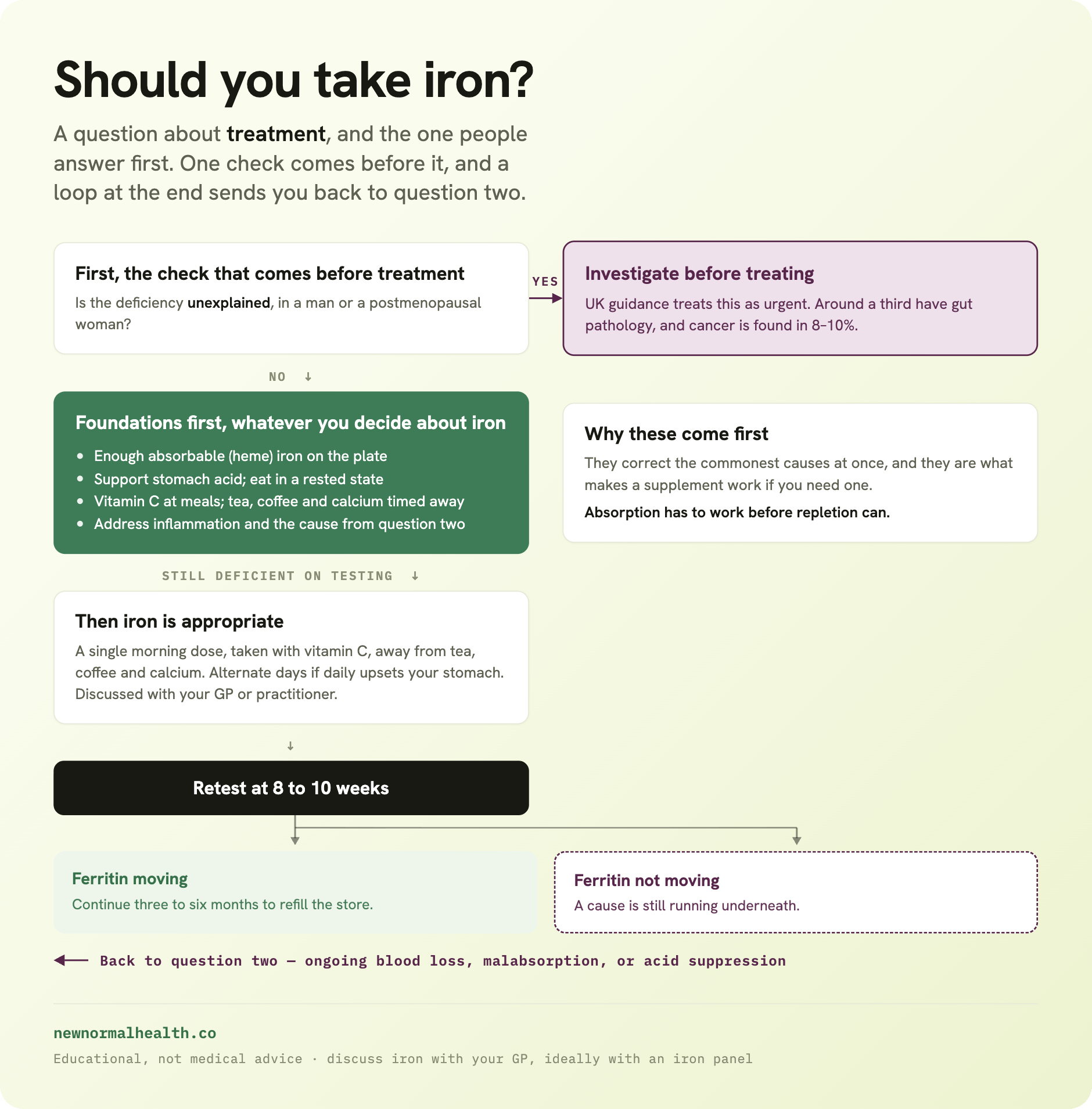
How much iron do you need a day?
Before absorption enters into it at all, there is a simpler problem: the daily target is higher than most diets reach. A lot of low iron is just not enough iron going in.
Women of reproductive age are advised around 18 mg a day. That is more than double the 8 mg for men, and vegetarians and vegans are advised roughly 1.8 times those figures again, which puts the target above 30 mg.
| Group | Recommended daily iron |
|---|---|
| Men (19 and over) | 8 mg |
| Women (19 to 50, menstruating) | 18 mg |
| Pregnancy | 27 mg |
| Breastfeeding | 9 mg |
| Postmenopausal women (51 and over) | 8 mg |
| Teenage girls (14 to 18) | 15 mg |
| Teenage boys (14 to 18) | 11 mg |
| Vegetarians and vegans | about 1.8 times the figures above |
These are US reference intakes (RDAs); UK figures run a little lower, around 14.8 mg for women and 8.7 mg for men.
Those numbers are larger than they look. Reaching 18 mg from red meat alone would take around 700 g of it a day. The target is set that high because only a fraction of what you eat crosses into you, and because menstruating women lose iron every month on top of it.
So there are two separate problems here, and it helps to know which is yours. Not eating enough iron is the common one, and it has nothing to do with how well your gut works. Not absorbing what you do eat is the second, and it is what the rest of this section covers.
Heme vs non-heme iron: why so little gets absorbed
You don’t absorb the iron you eat, only a fraction of it, often a small one.
Dietary iron comes in two forms. Heme iron comes from animal foods (meat, fish, organs) and absorbs well, in the region of 15 to 35%. Non-heme iron comes from plants and absorbs far less efficiently, anywhere from about 2 to 20% and usually at the low end (Carpenter & Mahoney, Critical Reviews in Food Science and Nutrition, 1992; Hallberg & Hulthén absorption model, American Journal of Clinical Nutrition, 2000). Meat is a mix, with roughly 30 to 70% of its iron in the well-absorbed heme form. Plants are entirely non-heme.
There is a second difference. Heme iron is absorbed at a fairly constant rate regardless of the rest of the meal. Non-heme absorption varies severalfold with what accompanies it. Plant iron therefore starts lower and is more easily blocked.
Best iron-rich foods (and the spinach myth)
Spinach illustrates the problem. On paper it is iron-rich, but the iron is non-heme and bound to oxalates, which reduce its absorption to a few percent.
Rank foods by the iron you absorb rather than the iron they contain, and the picture changes:
| Food | Form | Iron per 100g | Typical serving | Iron per serving | ≈ Absorbed per serving* |
|---|---|---|---|---|---|
| Liver (beef) | Heme | ~6.5 mg | 100 g | ~6.5 mg | ~1.5 mg |
| Oysters | Heme | ~5 mg | 6 oysters (~85 g) | ~4 mg | ~1.0 mg |
| Red meat (beef, lamb) | Heme | ~2.6 mg | 100 g | ~2.6 mg | ~0.6 mg |
| Sardines (tinned) | Heme | ~2.9 mg | 1 tin (~90 g) | ~2.6 mg | ~0.6 mg |
| Chicken (thigh) | Heme | ~1.3 mg | 100 g | ~1.3 mg | ~0.3 mg |
| Lentils (cooked) | Non-heme | ~3.3 mg | 1 cup (~200 g) | ~6.6 mg | ~0.5 mg |
| Spinach (cooked) | Non-heme | ~3.6 mg | 1 cup (~180 g) | ~6.4 mg | ~0.3 mg |
*Absorbed per serving is a rough estimate using typical rates (heme roughly 15 to 35%, non-heme roughly 2 to 20%, and lower again for high-oxalate greens like spinach). Actual absorption rises when your iron stores are low, and soaking, sprouting or fermenting legumes improves their non-heme absorption. Iron content values are approximate, from food composition databases.
Look at the last two columns side by side. A cup of cooked spinach lists more iron than a serving of red meat, yet provides roughly half as much. What matters is what crosses into you. In a study of healthy young women, heme iron intake predicted ferritin better than total iron intake did (Young et al., Nutrients, 2018). If you are rebuilding iron through food, a small amount of red meat, liver, or shellfish does more than a much larger serving of greens.
What blocks iron absorption: tea, coffee, calcium
Non-heme iron in particular is sensitive to what shares its meal. The main blockers:
- Tea and coffee. The polyphenols and tannins bind iron. Tea can cut non-heme absorption by up to about 60%, coffee by up to around 40%, and the effect is strongest right around the meal (Hurrell et al., British Journal of Nutrition, 1999). Matcha is concentrated in the same catechins and tannins.
- Calcium. A dose-dependent blocker, reducing iron absorption by roughly 18 to 50% depending on the amount (Hallberg et al., American Journal of Clinical Nutrition, 1991). Keep calcium supplements and large dairy servings away from your iron-rich meal.
- Phytates, in grains, legumes, and nuts. Even small amounts inhibit iron, and larger amounts can cut absorption by over 80% (Hallberg et al., American Journal of Clinical Nutrition, 1989). Soaking, sprouting, and fermenting reduce phytates.
The counterweight is vitamin C, which increases non-heme absorption and offsets some of the blocking. Timing matters. Keep tea, coffee, matcha, and calcium an hour or two away from iron-rich meals, and pair those meals with a vitamin C source (lemon, peppers, citrus, kiwi).
How to raise iron naturally, foundations first
The instinct with low ferritin is to reach straight for a supplement. Hold off. If you’re absorbing badly, if inflammation is locking iron away, if copper is too low to move it, or if you were never eating enough absorbable iron to begin with, more iron leaves all of that untouched. For most people, the foundations are the treatment itself.
Raising iron naturally looks like this:
- Eat enough absorbable iron. Regular, modest amounts of heme iron (red meat, liver, shellfish, poultry, fish) do more than large volumes of plant iron. This is the biggest lever, because many people sit under the threshold without knowing it.
- Support your stomach acid. Chew thoroughly, and try a tablespoon of apple cider vinegar in a little water shortly before a meal, which supports the acidity iron needs to be freed from food. If your acid is genuinely low, supplemental HCl at meals is the next step, but work through that with a nutritional practitioner rather than alone: too much stomach acid is its own problem, and the dose needs matching to you.
- Eat in a rested state. Digestion runs on the parasympathetic side of your nervous system, so eating while stressed, rushed or working suppresses stomach acid and the enzymes that go with it. Chronic stress also drives the inflammation that locks iron into storage, so this bullet is doing two jobs. A few slow breaths before you eat, sitting down, and putting the screen away are the whole intervention.
- Pair with vitamin C, or a little meat. A vitamin C source at the meal (lemon, peppers, citrus, kiwi) increases non-heme absorption and offsets the blockers; a small amount of meat, fish or poultry on the same plate has a similar effect. Keep tea, coffee, matcha, and calcium supplements an hour or two from the meal.
- Prepare plant sources properly. Soak, sprout, or ferment legumes and grains to bring the phytates down, if plants are a large part of how you eat. Organically grown produce also tends to run a little higher in iron than conventionally grown.
- Cook in cast iron. Wet, acidic dishes such as tomato sauce or chilli cooked in a cast-iron pan take up a measurable amount of iron (a Lucky Iron Fish works the same way), a useful addition if you eat mostly plants.
- Use blackstrap molasses. A tablespoon carries roughly 2 to 3.5 mg of iron depending on the brand, against a daily target of 18 mg for menstruating women. That is a real contribution from a spoonful in porridge, yoghurt or a warm drink. It is still non-heme iron, so it absorbs at plant-source rates: pair it with vitamin C and keep it clear of tea and coffee.
- Mind copper and inflammation. A little whole-food copper supports iron transport, and lowering chronic inflammation releases iron you already hold.
None of this is a supplement regime. It’s also what makes a supplement effective if you do need one: absorption has to work first.
Do you need to supplement?
You may have read that supplementing iron is a bad idea even when ferritin is low. That argument has a real basis, and it is worth understanding, but it does not apply to an isolated low ferritin: if testing shows you are deficient, iron helps. A placebo-controlled trial found iron reduced fatigue in non-anaemic women with low ferritin (Verdon et al., BMJ, 2003), and iron improved cognition in iron-deficient young women (Murray-Kolb & Beard, 2007). Especially if you menstruate heavily, food alone can be slow to refill deep stores.
Is iron overload something to worry about?
For most people, no. Your body has no active way to excrete excess iron, so overload is real, but it clusters in specific situations: hereditary haemochromatosis, repeated blood transfusions, or years of high-dose iron taken without a deficiency to absorb it. In anyone menstruating and losing iron every month, tipping into overload from food or from correcting a tested deficiency is uncommon. Fear of overload is not a reason to leave a confirmed deficiency uncorrected. Test before you treat, correct to a target rather than dosing indefinitely, and retest.
My position is to work the foundations first, because they address the most common causes at once: too little absorbable iron, poor absorption, meal-time blockers, inflammation, low copper. Then, if testing shows you’re deficient, iron is appropriate, and how you take it matters:
- Once a day is enough, and splitting doses backfires. Each dose spikes hepcidin, which blunts absorption of the next one, so the old several-times-daily advice worked against itself (Moretti et al., Blood, 2015). Take a single dose in the morning, and keep it clear of the couple of hours after hard exercise, when hepcidin runs high. Alternate-day dosing absorbs a higher fraction per dose (Stoffel et al., The Lancet Haematology, 2017), though head-to-head trials find it refills stores no faster than daily. It suits people whose stomachs object to daily iron.
- Don’t pay extra expecting a “gentler” form to do more. Compared at the same elemental dose, the different iron salts perform similarly, and much of the gentle reputation of forms like bisglycinate comes from trials that used half the iron. If ferrous sulfate disagrees with you, a lower dose or alternate days is the better-supported fix, and switching forms is fine to try. A standalone iron taken with vitamin C still beats the iron buried inside a multivitamin.
- Heme iron supplements cost more without performing better. Made by digesting haemoglobin from animal blood, and sold as beef, porcine or reindeer blood, these use the better-absorbed form of iron and are less affected by tea, coffee and calcium. The trials do not show an advantage in ferritin or haemoglobin. In peritoneal dialysis patients, ferritin after six months was lower on heme iron than on ferrous sulfate at seven times the cost (Barraclough et al., Nephrology Dialysis Transplantation, 2012), and in anaemic infants haemoglobin and ferritin corrected equally on both (Bah et al., American Journal of Clinical Nutrition, 2025).
- Lactoferrin works alongside iron and cannot replace it. This milk protein raised absorption of iron eaten with it by 56% in a stable-isotope study, with the iron-free (apo) form responsible for the effect (Mikulic et al., The Journal of Nutrition, 2020). It carries almost no iron itself, roughly 40 to 90 micrograms against 65 milligrams in a standard tablet, and in the one large blinded trial it moved ferritin by about 3 µg/L against 41 for ferrous sulfate. No trial has tested it in people with a low ferritin and a normal blood count, though anecdotal reports are promising.
- Have this conversation with your GP or practitioner, ideally with an iron panel in front of you, rather than guessing at doses.
Repletion is slow. Even with food, absorption and, where needed, dosing all correct, a retest typically takes 8 to 10 weeks to show measurable movement, and refilling depleted stores takes 3 to 6 months or longer. Many people who conclude that iron “didn’t work” stopped within the first month, before any change was measurable.
When low stores refuse to refill. If your ferritin won’t move despite months of good intake and, where needed, correct supplementing, one of the causes above is still running: ongoing blood loss, malabsorption, or acid suppression left unaddressed. That is the point to investigate with a doctor rather than continuing to add iron.
Iron deficiency without anaemia is common and treatable. Start with food and absorption, know your ferritin number, use supplemental iron thoughtfully when it’s needed, and give it months.
References
- Iron supplementation for unexplained fatigue in non-anaemic women (RCT) (BMJ, 2003)
- Iron treatment normalizes cognitive functioning in young women (American Journal of Clinical Nutrition, 2007)
- Serum ferritin is an important inflammatory disease marker (Metallomics, 2014)
- Adjusting plasma ferritin for subclinical inflammation (meta-analysis) (American Journal of Clinical Nutrition, 2010)
- Iron absorption in man: ascorbic acid and dose-dependent inhibition by phytate (American Journal of Clinical Nutrition, 1989)
- Calcium: effect of different amounts on nonheme- and heme-iron absorption (American Journal of Clinical Nutrition, 1991)
- Inhibition of non-haem iron absorption by polyphenolic beverages (British Journal of Nutrition, 1999)
- Prediction of dietary iron absorption: an algorithm (American Journal of Clinical Nutrition, 2000)
- Haem and non-haem iron intake and serum ferritin in healthy young women (Nutrients, 2018)
- A Red Carpet for Iron Metabolism (Cell, 2017)
- Hepcidin, a key regulator of iron metabolism and mediator of anaemia of inflammation (Blood, 2003)
- Iron absorption from supplements on consecutive versus alternate days (The Lancet Haematology, 2017)
- Oral iron supplements increase hepcidin and decrease iron absorption (Blood, 2015)
- Proton pump inhibitor and H2 receptor antagonist use and iron deficiency (Gastroenterology, 2017)
- Athletic induced iron deficiency: the role of inflammation and hepcidin (European Journal of Applied Physiology, 2008)
- Meta-analysis: efficacy of bovine lactoferrin in Helicobacter pylori eradication (Alimentary Pharmacology & Therapeutics, 2009)
- Iron absorption is greater from apo-lactoferrin than holo-lactoferrin (stable iron isotope study) (The Journal of Nutrition, 2020)
- Bovine lactoferrin compared with ferrous sulfate for iron-deficiency anaemia (randomised non-inferiority trial) (The Journal of Nutrition, 2026)
- Oral heme iron polypeptide versus oral iron supplementation for anaemia (HEMATOCRIT trial) (Nephrology Dialysis Transplantation, 2012)
- Heme iron compared with ferrous iron salts to treat iron deficiency anaemia in children (randomised trial) (American Journal of Clinical Nutrition, 2025)
Iron and ferritin: your questions answered
Can you have iron deficiency without anaemia?
Yes. Anaemia is the final stage. Your iron stores and circulating iron fall first, which is why you can feel deficient with a normal blood count. This early stage is called iron deficiency without anaemia, and it's best caught with a ferritin test.
Why am I so tired if my iron or ferritin is normal?
Two reasons. The normal range is wide, so a low-but-normal ferritin (roughly under 30 to 50) can still cause symptoms. And ferritin rises with inflammation, so a mid-range number can mask a low store underneath. Ask for the actual figure and a full iron panel.
What is a good ferritin level?
Labs call anything from about 12 upward normal, but symptoms of low iron often appear below roughly 30 to 50. Get the actual figure, read it alongside your symptoms, and discuss it with your GP rather than relying on the word normal.
What blood tests should I ask for to check my iron?
More than a haemoglobin. A fuller picture is ferritin (your iron stores), transferrin saturation and serum iron (the transport), a full blood count, and ideally CRP alongside, since inflammation can push ferritin up and hide a low store. Ask your GP for the numbers and their ranges, and discuss anything unclear with them.
Can low iron cause hair loss?
Diffuse hair shedding is one of the most common signs of low iron in women, and it often appears before anaemia does. Ferritin is the marker to check if your hair is thinning and you can't work out why.
Can low iron cause cold hands, anxiety, or low mood?
Feeling cold is a classic low-iron sign. Iron is also a cofactor for the enzymes that make dopamine and serotonin, so low iron can flatten mood, motivation and focus. These can all appear before anaemia.
What are the best iron-rich foods?
Ranked by the iron you absorb: liver and organ meats, oysters and shellfish, then red meat, then poultry and fish. Plant sources such as lentils, beans and leafy greens contain iron but in the harder-to-absorb non-heme form.
Is spinach a good source of iron?
Less than its reputation suggests. Spinach iron is the poorly absorbed non-heme form, and its oxalates reduce absorption further. Red meat, liver and shellfish provide far more absorbed iron per serving.
Does coffee or tea really block iron?
Yes, when taken with or near a meal. Tea can cut non-heme iron absorption substantially and coffee meaningfully too. Keep them, and matcha, about an hour or two away from iron-rich meals, and add vitamin C to the meal itself.
Does calcium block iron absorption?
Yes, in a dose-dependent way. A calcium supplement or a large dairy serving eaten with an iron-rich meal can reduce absorption by up to about half. Space calcium and iron a couple of hours apart.
Does vitamin C help iron absorption?
Yes, especially for non-heme (plant) iron. Adding a vitamin C source to the meal, such as lemon, peppers, citrus or kiwi, increases how much iron you take up and offsets some of the blocking from other foods.
Does heavy menstruation cause low iron?
Often, yes. Menstrual blood loss is one of the main reasons women become iron-deficient, and heavier periods raise the risk. If your periods are heavy and you're exhausted, test your ferritin.
Why is my iron still low even though I eat red meat or take a supplement?
A few reasons: you may not absorb it well (low stomach acid, gut issues), you may be blocking it (tea, coffee or calcium at meals), inflammation may be locking iron away in storage, or low copper may be stalling how your body recycles and uses iron. This is why absorption and foundations matter as much as intake. If it stays low for months despite getting all of that right, see your doctor to look for ongoing blood loss or an absorption problem.
How long does it take to raise ferritin?
It takes months. Even with everything done well, a retest usually needs about 8 to 10 weeks to show measurable movement, and refilling depleted stores commonly takes 3 to 6 months or more.
What's the best way to take an iron supplement?
If you and your practitioner decide you need one, take it as a single morning dose rather than split doses, because each dose raises hepcidin and blunts the next one's absorption. Daily and alternate-day dosing refill stores at a similar rate, so alternate days is a good option if daily iron upsets your stomach. Taking iron with vitamin C and away from tea, coffee and calcium also helps.
What actually causes iron deficiency?
One of three things, and it helps to know which. You're losing it (heavy periods are the most common cause in menstruating women, and the gut can bleed with no symptoms you'd notice), you're not absorbing it (coeliac disease, H. pylori, low stomach acid, long-term acid-suppressing medication), or you're not getting enough to meet demand (plant-based eating without pairing, undereating, pregnancy, growth, heavy training). The correction depends on the cause.
Can acid reflux medication (PPIs) cause low iron?
Yes. PPIs such as omeprazole and esomeprazole switch off stomach acid for most of the day, and acid is what frees iron from food and makes it absorbable, so long-term use lowers uptake of both food iron and supplements. Pairing iron with vitamin C helps. Ask your prescriber whether you still need the PPI; don't stop it on your own.
Should I worry about iron overload?
For most people, no. The body can't easily get rid of excess iron, so overload is real, but it clusters in specific situations like hereditary haemochromatosis, repeated transfusions, or years of high-dose iron taken without a deficiency. If you menstruate and lose iron every month, tipping into overload from food or from correcting a confirmed deficiency is uncommon. Test before you supplement, correct to a target, and retest.